
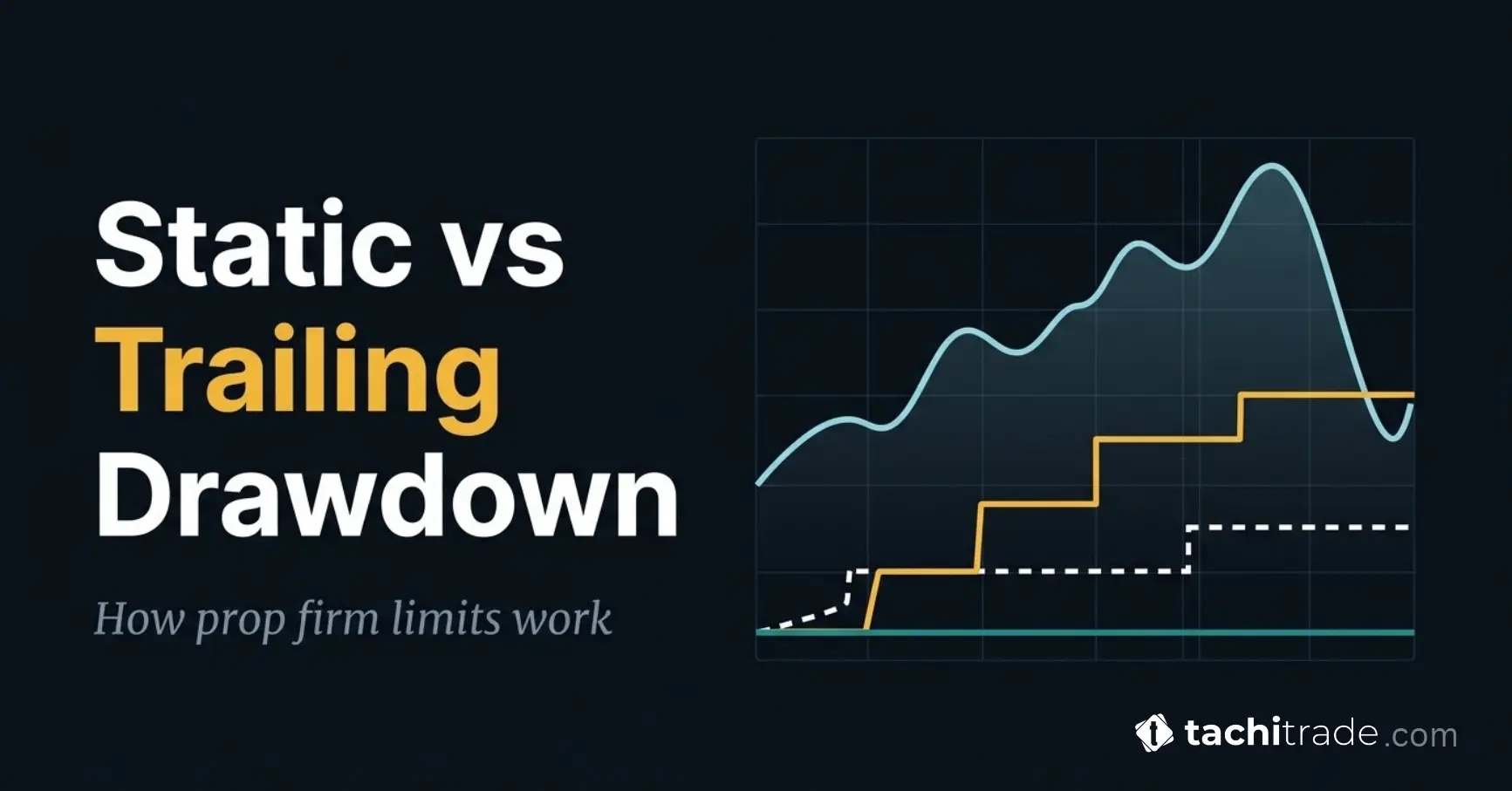
Two traders can place the exact same trades on the exact same day. One keeps the account. The other gets a breach email. The difference is often not skill. It is the drawdown rule: static vs trailing drawdown, measured on balance or on equity, reset at midnight or at some other hour.
This guide explains how prop firm drawdown rules work, using one $100,000 account and one trading path. You will see how a static, a trailing and an end-of-day trailing limit treat the same trades differently, how the daily loss limit is calculated, and what to check before you buy a challenge.
When you are ready to put your own numbers in, use our prop firm daily loss and drawdown calculator.
Two limits, not one
Almost every prop firm gives you two separate limits, and you must stay inside both:
- Daily loss limit. The most the account may lose in one day. It resets at a set time.
- Max loss (max drawdown). The most the account may lose in total. It does not reset.
Both are usually quoted as a percentage of the initial balance, such as 5% daily and 10% max. Each is a floor: a line of equity that you must never touch. Breaking either one usually ends the challenge or the funded account.
The part that surprises new traders is that the floor is not always where the percentage seems to put it. It depends on three choices the firm makes: what the limit is measured against (balance or equity), when the number is set (start of day, peak, end of day), and whether it moves.
Balance vs equity: the number that sets the floor
- Balance is your closed-trade result. It ignores open trades.
- Equity is balance plus the floating profit or loss of open trades.
A rule based on equity counts open trades in real time. A trade that is down 3% on paper counts as a 3% loss even though you have not closed it. A rule based on balance only moves when trades close, although many firms still check equity so that an open trade cannot hide a breach.
Always read which one the firm uses for each limit. Two firms can both say “5% daily loss” and mean quite different things.
Static drawdown
A static (fixed) max drawdown never moves. The floor is set from the starting balance and stays there.
On a $100,000 account with a 10% static max loss, the floor is $90,000 on day one and it is still $90,000 after you grow the account to $108,000. Profit builds a bigger cushion between you and the floor.
This is the most forgiving type. Good days make you safer, and the rule is easy to track: you only need one number.
Trailing drawdown
A trailing drawdown follows your account upward. The floor sits a fixed distance below the highest point your account has reached, and it rises when the peak rises. It never moves down.
Take the same $100,000 account with a $10,000 trailing drawdown:
- At the start, the floor is $90,000.
- If equity reaches $106,000 at any point, the floor moves to $96,000.
- If equity then falls back to $100,000, the floor stays at $96,000. You now have $4,000 of room, not $10,000.
Notice what happened: a trade floated +$6,000 and then closed flat. You made nothing, and you lost $6,000 of room.
Two details change how harsh a trailing rule is:
- What counts as the peak. If the peak uses equity, floating profit raises the floor even if you never close the trade. If it uses closed balance, only realised profit does.
- Whether the floor locks. Some firms stop the floor from rising once it reaches the starting balance. After that it behaves like a static floor. Others keep trailing.
End-of-day trailing drawdown
An end-of-day (EOD) trailing drawdown trails too, but it only updates once a day, using the closing balance or equity at the daily cut-off. Intraday highs do not move the floor.
On the $100,000 example, an intraday peak of $106,000 changes nothing if the day closes at $102,000. The floor for tomorrow is $102,000 − $10,000 = $92,000.
EOD trailing is kinder than intraday trailing because a spike that reverses within the day costs you nothing. It is still stricter than static, because every good close lifts the floor for good.
Some firms also check the daily loss only at the end of the day instead of in real time. Read the wording closely. “Evaluated at end of day” and “monitored in real time” are very different promises.
Static vs trailing drawdown on one account
Here is the same trading path run against all three rules. Account: $100,000. Drawdown size: $10,000.
- Day 1: equity peaks at $106,000 during the day, then closes at $102,000.
- Day 2: equity drops to a low of $95,500.
| Rule | Floor after day 1 | Room at the day 2 low | Result |
|---|---|---|---|
| Static | $90,000 | $5,500 | Alive |
| Trailing (intraday peak) | $96,000 | −$500 | Breached |
| End-of-day trailing | $92,000 | $3,500 | Alive |
The trades were identical. Only the rule changed the outcome. The trailing account was up $2,000 after day one and still failed on a $6,500 drop from the close.
How the daily loss limit is calculated
The daily limit is easy to misread because three things can differ: the starting point, the time it resets, and what counts as a loss.
Starting point. Firms commonly use one of these:
- Balance at the start of the day
- Equity at the start of the day
- The higher of the two
An example. Start of day: balance $100,000, but an open trade is floating +$1,500, so equity is $101,500. The daily limit is 5% of $100,000, which is $5,000.
| Daily start basis | Floor for the day | Room from $101,500 |
|---|---|---|
| Start-of-day balance | $95,000 | $6,500 |
| Start-of-day equity | $96,500 | $5,000 |
| Higher of the two | $96,500 | $5,000 |
Flip it so the open trade is losing $2,000 (equity $98,000) and the picture changes: a balance basis gives a floor of $95,000 and $3,000 of room, while an equity basis gives a floor of $93,000 and $5,000 of room.
Reset time. Some firms reset at midnight broker server time, others at a fixed hour in another time zone. Daylight saving changes can shift it. If you trade late in the session, a reset in the middle of your trading day gives you a fresh limit, or traps you with half a day left.
What counts. Spread, commission and swap normally count as losses. Floating losses count when the rule uses equity. Trades you plan to hold overnight carry their loss into the next day’s starting equity.
Turn the rule into a number you can trade
Rules are only useful as a number. Each day, work out your room:
- Daily room = current equity − (start-of-day base − daily limit)
- Max room = current equity − max floor
- Your real room is the smaller of the two.
Say the daily limit is 3% on a $100,000 account, the base is $100,000, so today’s floor is $97,000. You lose $1,800 in the morning. Your room is $100,000 − $1,800 − $97,000 = $1,200.
A full-size 1% trade ($1,000 at the stop) would leave only $200. Slippage, spread or a gap through the stop would end the day, or the account. This is why many traders set their own stop at 50% to 70% of the firm’s limit, and size trades from the room that is left rather than from the account size. Our The5ers position size calculator does that sizing from your remaining room, and our general position size calculator covers any account. For the formula behind lot sizes, see how to calculate lot size.
Open trades matter here. With several positions open, the loss if every stop is hit is what you should compare with your room. A portfolio risk calculator adds that up, including trades with no stop loss.
The5ers numbers
The5ers is the firm we cover most on this site. These figures come from the plan table we checked on October 9, 2026, for MetaTrader accounts in USD. Firms change their rules, so confirm them on the official page before you buy.
| Plan | Steps | Profit target | Max loss | Daily limit |
|---|---|---|---|---|
| High Stakes | 2 | 8% then 5% | 10% (static, equity) | 3% |
| Hyper Growth | 1 | 10% | 6% | 3% (“Daily Pause”) |
| Pro Growth | 1 | 10% | 6% | 3% (“Daily Loss”) |
| Bootcamp | 3 | 6% per step | 5% per step | No separate daily row in the table we checked |
We did not match every plan against a live dashboard. We only did that for High Stakes, where the max loss level stayed fixed and the daily level followed the day’s starting equity on the account we looked at. Check the starting basis and reset hour for your own plan on the official rules page and in your dashboard.
Open The5ers through our link to check the current rules and plans. This is an affiliate link: if you sign up through it we may earn a commission at no extra cost to you. See our affiliate disclosure. TachiTrade’s tools are independent and are not operated by The5ers. Passing a challenge is never guaranteed.
Checklist before you buy a challenge
- Is max loss static, trailing on equity, trailing on balance, or end-of-day trailing?
- If it trails, does the floor lock at the starting balance?
- Is the daily limit based on start-of-day balance, equity, or the higher of the two?
- What time does the day reset, and does it follow daylight saving?
- Do floating losses count in real time, or only closed trades?
- Do spread, commission and swap count toward the limit?
- What happens at a breach: lose the account, or a one-day pause?
- Is there a minimum number of trading days or a time limit?
Write the answers next to your profit target, and note whether you are dealing with static vs trailing drawdown. The challenge target pace calculator turns the target and your trading days into a daily pace, and the drawdown recovery calculator shows how much harder it gets to climb back after a loss.
Track it live instead of by hand
Doing this by hand is fine for planning. In a live session, a missed number is where accounts break. Our own Tachi Prop Guard for MT5 tracks the daily loss and max drawdown on your account, with a choice of start-of-day basis (balance, equity or the higher) and a static or trailing floor (from the equity peak or the balance peak). In Monitor mode it alerts you. In Protect mode it can close trades and lock trading until your reset time.
It has limits you should know. It cannot stop another EA’s order before that order is sent, it cannot guarantee fills during gaps or over the weekend, it gives no signals, and it does not guarantee you pass any challenge.
See Tachi Prop Guard on MQL5. This is our own product, and we earn money if you buy it. More tools for prop traders are on our prop firm hub.
Frequently asked questions
What is the difference between static and trailing drawdown?
A static drawdown floor is fixed from the starting balance and never moves. A trailing floor rises with your highest equity or balance and never falls. Trailing is stricter because gains you later give back still raise the floor.
Is a trailing drawdown calculated on balance or equity?
It depends on the firm. Some use the highest equity, including floating profit. Others use the highest closed balance. Equity-based trailing is harsher because an open trade that spikes and reverses still lifts the floor.
What is end-of-day drawdown?
It is a trailing floor that updates only at the daily cut-off, based on the closing balance or equity. Intraday highs do not move it. Some firms also evaluate the daily loss only at the end of the day, so check which meaning applies.
Does the daily loss limit include open trades?
When it is based on equity, yes. Floating losses count in real time. When it is based on balance, check whether the firm still monitors equity. Many do, so that open losses cannot hide a breach.
Which drawdown type is best for a challenge?
In a static vs trailing drawdown comparison, a static max loss is the easiest to manage, and end-of-day trailing is easier than intraday trailing. The best rule is the one you fully understand and can size your trades around. Pick the firm after you have read the drawdown wording, not just the headline percentage.
Key takeaways
- Every prop firm has a daily floor and a max floor. Your real room is the smaller gap.
- In the static vs trailing drawdown comparison, static floors stay put. Trailing floors rise with the peak and never fall. End-of-day trailing updates once a day.
- The same trades can pass under one rule and fail under another.
- Check the basis (balance or equity), the reset time and what counts as a loss.
- Size trades from the room that is left, with a buffer.
Trading leveraged products carries a high risk of loss. This article is educational, not financial advice, and does not promise you will pass a prop firm challenge. Read our risk disclaimer and see how our tools are built.