
USDJPY Pip Value in USD & Lot Size
The USDJPY pip is paid in yen, so its dollar value moves with the rate. Enter your balance, risk and stop to get the lot size, the pip value in USD and the margin for your leverage.
- Yen converted to USD
- Lot size from risk
- Margin by leverage
- Rate drift table
- Contract (typical)
- 100,000 USD
- Pip used here
- 0.01
- Pip value, 1 lot
- JPY 1,000 ≈ $6.67
- Margin formula
- see section 1
Broker specification (change if yours differs)
Educational calculator for USD accounts. Results are estimates; check contract size, margin rules and rounding with your broker. See the risk disclaimer.
USDJPY contract specification
Typical values; read your own under Specification in MetaTrader.
| Item | Value |
|---|---|
| Symbol | USDJPY |
| Base / quote | USD / JPY |
| Contract size, 1 lot | 100,000 USD (typical, verify) |
| Pip used on this page | 0.01 |
| Pip value per lot, USD account | JPY 1,000, about $6.67 at 150.00 |
| Margin formula | lots × 100,000 ÷ leverage (the price does not matter) |
| Smallest lot step | 0.01 at most brokers (verify) |
| Where to confirm | MetaTrader: Market Watch, right-click the symbol, Specification |
| Price digits | Usually 3 (the last digit is a tenth of a pip) |
A pip paid in yen, converted to dollars
On USDJPY the pip is 0.01 and a standard lot of 100,000 dollars earns or loses 1,000 yen per pip. Your account is in dollars, so that 1,000 yen is converted at the current USDJPY rate. The higher the rate, the fewer dollars each yen is worth.
| USDJPY rate | Pip value, 1 lot (JPY) | Pip value, 1 lot (USD) | 20-pip stop, 1 lot |
|---|---|---|---|
| 110 | JPY 1,000 | $9.09 | $181.82 |
| 120 | JPY 1,000 | $8.33 | $166.67 |
| 130 | JPY 1,000 | $7.69 | $153.85 |
| 140 | JPY 1,000 | $7.14 | $142.86 |
| 150 | JPY 1,000 | $6.67 | $133.33 |
| 160 | JPY 1,000 | $6.25 | $125.00 |
| 170 | JPY 1,000 | $5.88 | $117.65 |
The pip value is not fixed. A trade that costs $6.67 per pip at 150 costs $9.09 per pip at 110. Over a long period, the same lot size carries a different risk.
Same risk, different lot size
Suppose you risk $100 with a 20-pip stop. The lot size that does that depends on where USDJPY trades. The second column shows what happens if you keep the same lot size while the rate moves:
| USDJPY rate | Lots for $100 risk, 20-pip stop | Risk if you keep 0.75 lots |
|---|---|---|
| 110 | 0.55 | $136.36 |
| 120 | 0.60 | $125.00 |
| 130 | 0.65 | $115.38 |
| 140 | 0.70 | $107.14 |
| 150 | 0.75 | $100.00 |
| 160 | 0.80 | $93.75 |
| 170 | 0.85 | $88.24 |
This is why a lot size you wrote down last year is not safe to reuse. Recompute it from the current rate each time.
Margin does not use the price
The dollar is the base currency, so one lot is always 100,000 dollars of position value. Margin is that amount divided by leverage, with no price in the formula.
| Lot size | 1:30 | 1:100 | 1:200 | 1:500 |
|---|---|---|---|---|
| 0.10 lots | $333.33 | $100.00 | $50.00 | $20.00 |
| 0.50 lots | $1,666.67 | $500.00 | $250.00 | $100.00 |
| 1.00 lots | $3,333.33 | $1,000.00 | $500.00 | $200.00 |
| 2.00 lots | $6,666.67 | $2,000.00 | $1,000.00 | $400.00 |
Three tickets at 150.00
Example prices, not live quotes.
Small account
A 25-pip stop on a small balance.
Standard
The same 20-pip stop as the table.
Wider stop
Half a percent with a wider stop.
Where USDJPY bites
USDJPY can move fast on rate decisions and on official comments about the yen, and a stop can be filled beyond its price. Because the dollar value of each pip also shifts with the rate, keep your risk per trade modest and recompute the lot size instead of copying an old one.
Let the chart do the yen sum
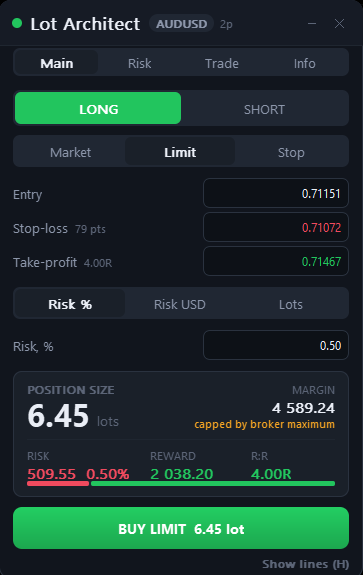
Because the pip value moves with the rate, the lot size has to be worked out every time. Lot Architect shows size, margin and risk on your MetaTrader chart, using the specification your broker supplies.
- Size by risk %, risk in USD or fixed lots
- Drag Entry, SL and TP lines on the chart
- Shows size, margin, risk, reward and R:R
- MT5 and MT4 versions
Lot Architect is our own product, so we earn money if you buy it. It reads your broker’s specification from the platform. It does not guarantee profits.
Need a live account to read the specification from? Contract size, leverage and spread differ by broker and account type. This is our referral link to Exness; we earn a commission if you open an account through it, at no extra cost to you. It is not a recommendation to use high leverage, and availability depends on your country. See our affiliate disclosure.
USDJPY calculator FAQ
What is the pip value of USDJPY in dollars?
It is 1,000 yen per standard lot divided by the USDJPY rate. At 150 that is about $6.67; at 110, about $9.09.
Is a pip 0.01 or 0.001?
A pip on USDJPY is 0.01. Many brokers show a third decimal, which is a tenth of a pip, sometimes called a point or pipette.
Why does my margin not change with the price?
Because the dollar is the base currency, one lot is 100,000 dollars whatever the rate. EURUSD margin depends on the price because the euro is the base.
Can I use this with a yen account?
The ticket assumes a USD account. With a yen account, the pip value is 1,000 yen per lot and no conversion is needed.
Does the rate I type matter?
Yes. It converts yen to dollars. Use the live price from your chart when you size a trade.
Why is my lot size different from last month?
If USDJPY moved, the dollar value of each pip moved with it, so the lot size for the same risk changed.
Related tools
How our tools are built: methodology.