
US30, NAS100 and US500 Pip Value and Lot Size Calculator
Indices have no pips, so a lot size means nothing until you know what one point is worth. This US30 pip value calculator, which also covers NAS100, US500 and oil (WTI and Brent), turns your stop, risk and broker contract into lots, margin and R:R.
- Points and dollars, no pips
- Your own contract size
- Margin and R:R included
- WTI and Brent included
US30 buy at 42,000, $10,000 balance, 1% risk, $1 per point per lot, 1:100.
Illustrative numbers. Check the value of one point on your own account.
Trade
Account and risk
Contract card
Same risk, three indices
Your risk and stop in points applied to the three indices at the example prices, with 1 lot paying $1 per point and your leverage. The same points mean a very different share of the price.
Indices have points, not pips
A pip is a forex convention. Index CFDs do not have one. Brokers quote an index in points: when US30 moves from 42,000 to 42,001, that is one point. Some brokers show two decimals, so the smallest price step can be 0.01 or 0.1, but the point is still the whole number step.
What one point is worth in money depends on the contract size your broker sets for that symbol. With a contract size of 1, one lot gains or loses $1 for each point. With a contract size of 10, it is $10. The lot number alone tells you nothing until you know which one you have.
That is why a search for a US30 pip value really asks for the dollar value of one point per lot. This calculator takes that number from you, and tells you where to find it.
Brokers name these indices differently. US30 is the Dow Jones Industrial Average, NAS100 the Nasdaq 100 and US500 the S&P 500, but you may see names such as USTEC or US100 on your platform. Pick the closest button, or use Custom and enter your own numbers.
Lot size by risk and stop distance
Lots are rounded down to 0.01, so the risk you actually take is a little below your budget. The first table assumes one lot pays $1 per point, the second $10 per point.
| Risk | 10 pts | 25 pts | 50 pts | 100 pts | 200 pts |
|---|---|---|---|---|---|
| $50 | 5.00 | 2.00 | 1.00 | 0.50 | 0.25 |
| $100 | 10.00 | 4.00 | 2.00 | 1.00 | 0.50 |
| $250 | 25.00 | 10.00 | 5.00 | 2.50 | 1.25 |
| $500 | 50.00 | 20.00 | 10.00 | 5.00 | 2.50 |
| $1,000 | 100.00 | 40.00 | 20.00 | 10.00 | 5.00 |
| Risk | 10 pts | 25 pts | 50 pts | 100 pts | 200 pts |
|---|---|---|---|---|---|
| $50 | 0.50 | 0.20 | 0.10 | 0.05 | 0.02 |
| $100 | 1.00 | 0.40 | 0.20 | 0.10 | 0.05 |
| $250 | 2.50 | 1.00 | 0.50 | 0.25 | 0.12 |
| $500 | 5.00 | 2.00 | 1.00 | 0.50 | 0.25 |
| $1,000 | 10.00 | 4.00 | 2.00 | 1.00 | 0.50 |
Read across a row: a $100 risk with a 100-point stop is 1.00 lots in the first table and 0.10 lots in the second. The risk is the same, the lot number is ten times different. If you copy a lot size from someone else, you copy their contract size too.
Lot size for US oil (WTI) and Brent
Oil CFDs work like indices in this calculator: you give the stop distance, and the value of one unit of price movement per lot sets the lot size. Oil is quoted in dollars per barrel. On many MT5 accounts one lot is 1,000 barrels, which means a $1 move in the price is worth $1,000 per lot. Some brokers use 100 barrels per lot, which makes it $100.
Choose US Oil or Brent in the calculator and the contract card fills in 1,000 as the starting value. Treat it as a starting point and replace it with the number from your own symbol Specification. The example prices on this page, 65.00 and 69.00, are round numbers and not live quotes.
| Risk | $0.25 stop | $0.5 stop | $1 stop | $2 stop | $3 stop |
|---|---|---|---|---|---|
| $50 | 0.20 | 0.10 | 0.05 | 0.02 | 0.01 |
| $100 | 0.40 | 0.20 | 0.10 | 0.05 | 0.03 |
| $250 | 1.00 | 0.50 | 0.25 | 0.12 | 0.08 |
| $500 | 2.00 | 1.00 | 0.50 | 0.25 | 0.16 |
| $1,000 | 4.00 | 2.00 | 1.00 | 0.50 | 0.33 |
With 100 barrels per lot, the same stop pays one tenth as much per lot, so every lot figure in the table is ten times larger. A $100 risk with a $0.50 stop is 0.20 lots at 1,000 barrels and 2.00 lots at 100 barrels.
Margin on oil
Margin is lots times the value of one price unit per lot, times the price, divided by leverage. The table assumes 1,000 barrels per lot. Commodity leverage is often lower than forex leverage and differs by broker, so check it on your own account.
| Leverage | US oil at 65.00 | Brent at 69.00 |
|---|---|---|
| 1:10 | $6,500.00 | $6,900.00 |
| 1:20 | $3,250.00 | $3,450.00 |
| 1:50 | $1,300.00 | $1,380.00 |
| 1:100 | $650.00 | $690.00 |
What is different about oil
Symbol names differ by broker. You may see USOIL, XTIUSD, WTI or something similar for US oil, and UKOIL or XBRUSD for Brent, so confirm what your symbol tracks in its Specification. Many oil CFDs follow futures contracts, which means the broker may roll the price from one contract month to the next, and the chart can show a step when that happens. Oil can also gap on news or at the weekly open, so a stop can fill beyond its price. In April 2020 the WTI futures price went below zero, and brokers handled that in different ways. Read your broker rules for commodities before you trade them.
If you hold an oil trade overnight, financing applies; use our swap calculator to estimate it. For gold, use the XAUUSD lot size calculator.
One hundred points means different things
A fixed number of points is a different share of the price on each index. The example prices below are round numbers for illustration, not live quotes.
| Stop | US30 at 42,000 | NAS100 at 21,000 | US500 at 6,000 |
|---|---|---|---|
| 25 points | 0.060% | 0.119% | 0.417% |
| 50 points | 0.119% | 0.238% | 0.833% |
| 100 points | 0.238% | 0.476% | 1.667% |
| 200 points | 0.476% | 0.952% | 3.333% |
A 100-point stop is a small move on US30 and a much larger one on US500. This is why a stop in points copied from one index rarely fits another, and why the calculator shows the stop as a percentage of price.
Find the contract spec in MT5
- Open Market Watch (Ctrl+M) and find your index symbol.
- Right-click it and choose Specification.
- Read Contract size, Tick size, Tick value, Minimal volume and Volume step.
- Enter them in the contract card above.
Specifications can differ between account types and even between servers of the same broker, so read them from the account you will trade, not from a forum post or a screenshot.
What one lot ties up
Margin grows with the index price and shrinks with leverage. The table assumes 1 lot pays $1 per point at the example prices above.
| Leverage | US30 at 42,000 | NAS100 at 21,000 | US500 at 6,000 |
|---|---|---|---|
| 1:20 | $2,100 | $1,050 | $300 |
| 1:50 | $840 | $420 | $120 |
| 1:100 | $420 | $210 | $60 |
| 1:200 | $210 | $105 | $30 |
Brokers often set a lower maximum leverage on indices than on forex, and each one has its own margin call and stop-out rules. For a closer look at the stop-out price, use our leverage and stop-out calculator or the margin calculator.
Need an MT5 account to read specs from? We have an affiliate link with Exness: if you open an account through it, we earn a commission. We do not rank brokers, and this page says nothing about the index specifications or leverage of any broker.
Read our affiliate disclosure. Trading leveraged products carries a high risk of loss; see the risk disclaimer.
Six trades you can load
Each one loads into the calculator above. The fourth is the first trade again with a $10 contract: same risk, same margin, one tenth of the lots. The last two are oil.
US30 buy at 42,000, $10,000 balance, 1% risk, 100-point stop, 200-point target, 1:100, $1 per point per lot. Result: 1.00 lots, risk $100.00, margin $420.00, reward $200.00 (R:R 1:2.00).
NAS100 sell at 21,000, $5,000 balance, 1% risk, 60-point stop, 120-point target, 1:100, $1 per point per lot. Result: 0.83 lots, risk $49.80, margin $174.30, reward $99.60 (R:R 1:2.00).
US500 buy at 6,000, $2,000 balance, 2% risk, 20-point stop, 40-point target, 1:100, $1 per point per lot. Result: 2.00 lots, risk $40.00, margin $120.00, reward $80.00 (R:R 1:2.00).
US30 buy at 42,000, $10,000 balance, 1% risk, 100-point stop, 200-point target, 1:100, $10 per point per lot. Result: 0.10 lots, risk $100.00, margin $420.00, reward $200.00 (R:R 1:2.00).
US oil (WTI) buy at 65.00, $10,000 balance, 1% risk, $0.5 per barrel stop, $1 target, 1:20, $1,000 per $1 move per lot (1,000 barrels). Result: 0.20 lots, risk $100.00, margin $650.00, reward $200.00 (R:R 1:2.00).
Brent sell at 69.00, $5,000 balance, 1% risk, $0.8 per barrel stop, $1.6 target, 1:20, $1,000 per $1 move per lot (1,000 barrels). Result: 0.06 lots, risk $48.00, margin $207.00, reward $96.00 (R:R 1:2.00).
Set the lot on the chart
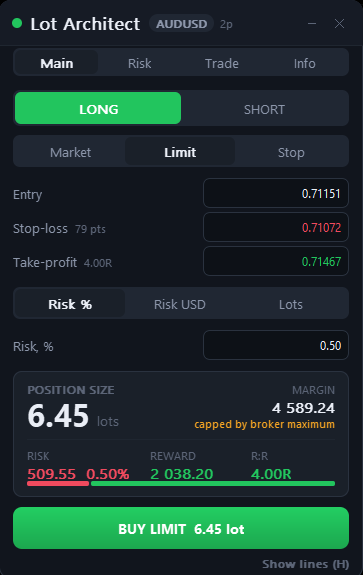
Lot Architect lets you drag the Entry, SL and TP lines on the chart and shows size, margin, risk, reward and R:R as you move them. Size by Risk %, Risk USD or fixed lots, and the order button shows the lot it will send.
It does not read prop firm rules. Index contract specs differ between brokers, so compare the lot it shows with this page for your own symbol before you trade with it. It is our own product, and we earn money if you buy it.
US30 pip value calculator FAQ
What is the pip value of US30?
US30 has no official pip. Its price moves in points, and the money value of a point depends on your broker contract size. With a contract size of 1, one lot pays $1 per point, but you should confirm this in the symbol Specification.
How do I calculate lot size for NAS100?
Divide the money you are willing to lose by the stop distance in points times the value of one point per lot. Risking $100 with a 60-point stop and $1 per point gives 1.666 lots, which rounds down to 1.66 at a 0.01 step.
How many points is a pip on US30?
There is no standard answer. Some platforms and calculators treat one point as one pip, others use 0.1. To avoid confusion, this page works in points and asks you to confirm what one point is worth on your account.
Why is my lot size different from another calculator?
The usual reasons are a different contract size, a different definition of a point, or rounding. This calculator rounds down to your lot step so that the planned risk never exceeds your budget.
Does it include spread, swap or commission?
No. The spread field is only used for a check against your stop. Swap, commission and slippage are not in the numbers, and indices can gap at the open or over the weekend, so a stop can fill beyond its price. The result shows planned risk, not the worst case.
How is margin calculated?
Lots times the value of one point per lot times the entry price, divided by your leverage. Brokers may use a different leverage for indices or a tiered scheme, so treat the number as an estimate and check your platform.
How do I calculate lot size for US oil (WTI)?
Divide the money you are willing to lose by the stop in dollars per barrel times the value of a $1 move per lot. Risking $100 with a $0.50 stop and 1,000 barrels per lot gives 0.20 lots, because a $1 move is worth $1,000 per lot. Check the contract size in your symbol Specification first.
How many barrels is one lot of oil?
It depends on the broker and the symbol. Many MT5 accounts use 1,000 barrels per lot and some use 100, so read Contract size in the Specification instead of assuming.
Can I use it for DAX, FTSE or Nikkei?
Yes, choose Custom. Enter the price, the value of one point per lot from the Specification, and the currency rate if the index currency differs from your account currency.
Related tools
How our tools are built: methodology.